Notes
EU AI Act transparency for Czech e-shops, since August 2026
Article 50 is in force. For a typical shop that is a chatbot disclosure and a closer look at synthetic images, not a certification project. This is not legal advice.
Since 2 August 2026, Article 50 of the EU AI Act has been applying to the transparency duties that actually reach a typical e-shop. I still get calls that treat this as a certification programme, or as a reason to delay a support bot. For most Czech and EU stores I see, it is narrower than that.
You are usually a deployer of a limited-risk system, not the provider of a high-risk one. You are not in the biometric, credit-scoring, or employment boxes. The work is to tell people when they are talking to a machine, and to be honest about synthetic media that could pass for a real photo or clip. It is not a model audit, and it is not a lawyer-shaped project unless you are close to those high-risk uses.
This is how I read it for a shop. It is not legal advice. If your case is odd, take it to a lawyer who does this for a living.
What actually triggers it in a store
Two situations, in practice.
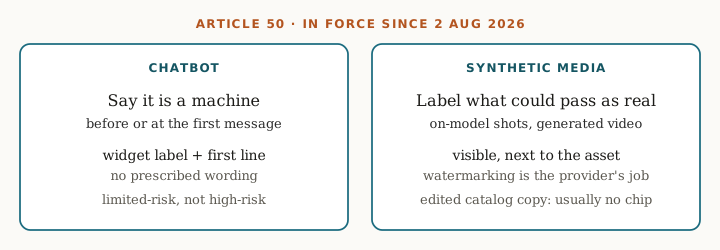
A chatbot or assistant a customer could take for a person. The widget in the corner, a WhatsApp number that replies in Czech, a “stylist” in the product page that writes in the first person. Article 50(1) puts the primary duty on providers of systems meant to talk to people: the system has to make clear that it is an AI system, unless that is obvious from the circumstances. If you embed someone else’s model, you still own the moment the customer sees. Put the disclosure in the widget and in the first message. There is no magic wording. “You are chatting with an assistant, not a person. A colleague will join if you need one.” is enough. Do it before or at the first turn, not after three messages of small talk.
AI-generated or heavily manipulated images, audio, or video that could pass for a recording of real people or real products. Deepfake-style rules sit on deployers under Article 50(4). A lifestyle shot of a model who does not exist, wearing a jacket you sell, is the case I would not shrug off. A packshot composited onto a white background, obviously a catalog image, is a different call. When in doubt, label the first kind in a way a reasonable person would notice, next to the image, not in a footer three scrolls down.
Machine-readable watermarking (the “this file was made by a generator” mark) is mainly a provider duty under Article 50(2). Midjourney or a similar tool should be doing that. Your job as a shop is the human-facing label where the content could mislead, not to invent a watermarking stack.
What does not need a sticker on every SKU
I keep getting asked whether every product description drafted in ChatGPT needs “AI generated” on the page.
The text rule in Article 50 is aimed at AI-generated text published on matters of public interest, with an exemption when a human has reviewed it and takes editorial responsibility. A size chart, a care paragraph, a title rewrite for 4,000 SKUs: that is not a news article. A merchandiser who edits the output and ships it under the shop’s name is doing ordinary catalog work. I would not put a visible “written by AI” chip on every PDP for that reason.
That is a judgment, not a waiver. If you generate fake reviews, fake “customer photos”, or a video of a person unboxing a product they never held, you are in a different conversation. Label those. Better: do not ship them.
The high-risk titles in the Act (biometrics, employment, credit) are not “we use an LLM somewhere”. A shop chatbot that answers “where’s my order” is limited-risk transparency, not an Annex III system. Vendors who open with “you will need a conformity assessment” for that widget are selling fear.
What I actually check in an audit
When this is in the first week of an engagement, I look at three things and write them down.
- Every customer-facing conversational surface: site widget, marketplace inbox automation, WhatsApp, email autoresponder that is now an LLM. Does it disclose, before or at first contact? Screenshot it.
- Generated or heavily edited images and video on PDPs, ads, and lookbooks. Would a reasonable person think this is a photograph of a real sitting? If yes, is there a visible disclosure? If you are not sure, that is the item to take to counsel.
- A one-page record: what you decided, who owns the wording, when you last checked. “We talked about it in a meeting” does not survive a complaint. A dated note in the repo or the wiki does.
For a Shoptet or Shopify store with one widget and a photographer who still shoots the catalog, this is often a day. The disclosure copy, a check of the image pipeline, the note. Not a programme.
If you generate thousands of on-model images from a seed photo, or you run a “virtual try-on” that puts a stranger’s face on a body, budget more than a day and talk to a lawyer. Those are the cases where Article 50(4) stops being theoretical.
What this is not
It is not a reason to freeze the chatbot until 2027. The duty is to disclose, not to unplug.
It is not a substitute for the other law you already have: consumer rules on misleading product claims, GDPR if you log chats, platform terms if you sell on marketplaces. Article 50 does not cancel those.
It is not legal advice. I will map what I see on your site, draft disclosure wording, and flag the gaps I would not want to defend. A binding assessment is a lawyer’s job, especially if you do anything with faces, credit, or hiring.
If you are not sure which box you are in, that is the first thirty minutes of a call. Bring the widget and two PDP URLs. We can usually tell.